Rebecca Douglass
Sentieri houses a handful of tables.
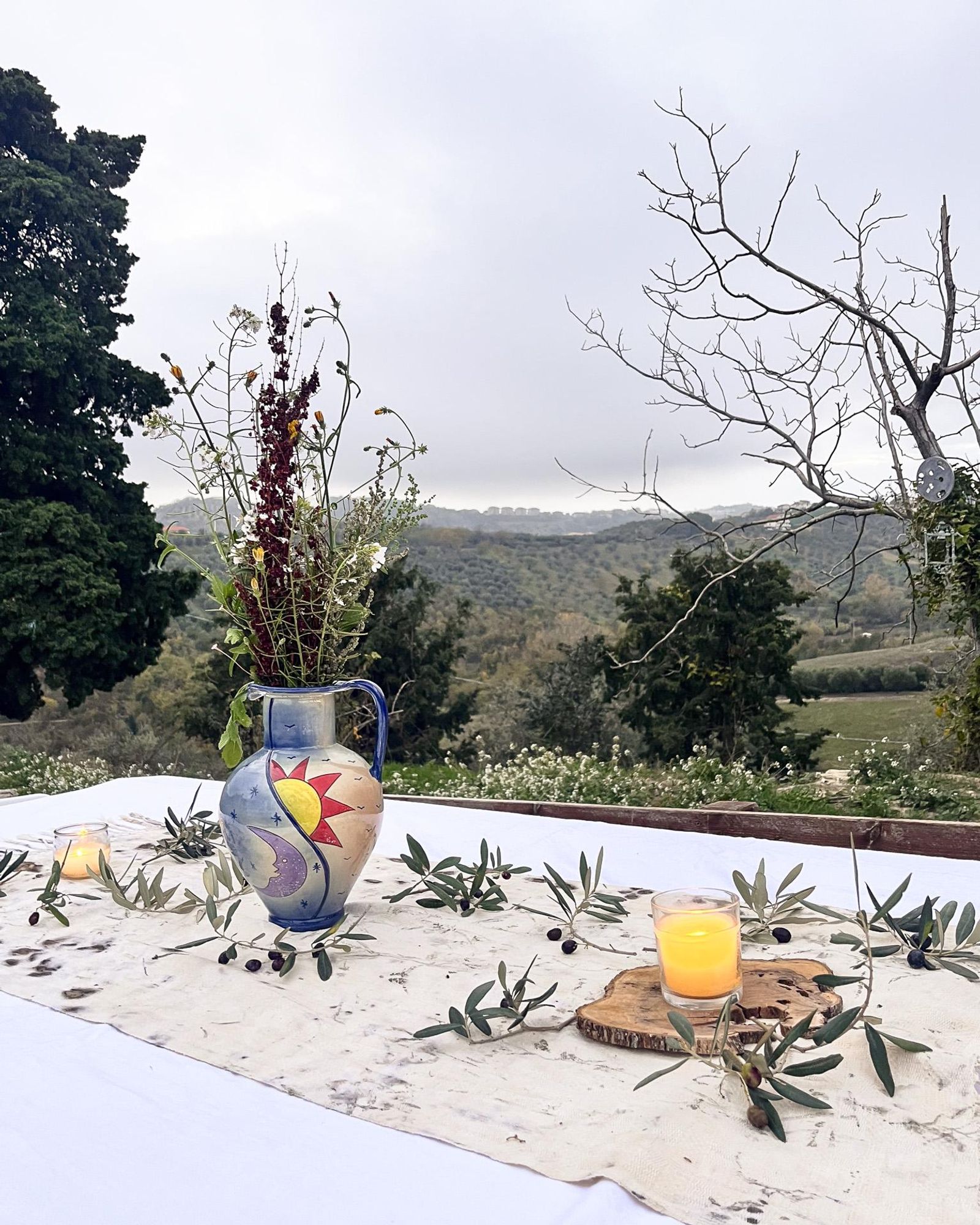
There's the small and only ever so slightly rectangular one that hosts most of the action. Its popularity can most likely be attributed to its prime location. One can take a coffee, indulge in a pasta-laden lunch post morning farm duties, or pass the evenings with a glass of local wine whilst drinking up phenomenal views of rippling hills, birds, trees, even a castle! And, nestled under the stone portici, all this can be achieved once removed from any sticky, hot sun, sudden rain or raging storm. Here notebooks have been splayed open and filled with gleeful ease, inspiration from conversations, flavours and sights flooding onto the pages. We've digested meals of such simple splendor made from vegetables plucked from the garden a mere 15 metres from our seat. Here we've sat in silence at 6am - silence between companions that is rare but when arrives is so beautiful and comforting it makes the early mornings seem like a welcome gift.
There's the round one tucked quietly in the corner of the living room, dressed with table runners, laptops and piles of paper plans. I was there when we hauled this table out from the 5th floor apartment of a local nonna, emptying her home in preparation for moving to the city, and generously giving away what was no longer needed. Passing through hands, there's a legacy of dinnertime memories inscribed in the fabric of this table. Her drawn-out meals with friends, family, or alone; her grand ideas, her writing, thinking, planning - all of this somehow lives between the cracks on the surface.
Quite unmissable is the heavy duty wooden ox that commandeers the kitchen. Rarely used for sitting (in fact, I've not seen it accompanied by a chair) this sturdy relic absorbs the impact of the culinary happenings at Sentieri. The surface boasts great bowls of freshly picked tomatoes, plums, peppers, basil that are replenished by the second. Multiple hands wipe, chop, scratch, grab, push, pull to the rhythm of the day's designated chef, table taking it all in with ease.
Less conventionally, there's the fold-out plastic table. What it lacks in visual charm it makes up for in convivial potential, accompanying every spontaneous barbeque or bonfire; lightweight and eager to prop up plates of uncooked meats and bottles of beers, observing them diminish as the night draws longer, the embers burn brighter and voices get louder.
And there's likely ones I've missed, either for sake of time or (most probably) because there are just too many to remember.
What this article is not is a descriptive catalogue of Sentieri's many surfaces. I feel compelled to spotlight the humble table as an ode to the importance of something a lot more significant than home furnishings. Spending time here on residency or as part of the harvesting team secures you a seat at the dining table, a cornerstone of Sentieri's mission - to create a community working towards innovative creative research that occurs in tandem with the activity and produce of the surrounding land; to find moments, places, environments in which the sharing of ideas, visions for the futures, and (of course) amazing food allows for a kind of practising of alternative modes of living and creating.
As our world steams towards unstoppable avarice, and the pace of daily existence becomes unlivable, our commitment to nourishment begins to crumble. As such, eating together becomes a rarity. The food collective Tabili highlights that as the act of eating together disappears, so too does the table: and so we witness "the disappearance of human connection, cultural expression, exchange, and the feeling of belonging to a collective or group". I noticed this shift in my own life when my parents began serving family dinners at the small kitchen island, craning up at the TV that hailed over the small eating station instead of staring across at familiar faces. Suddenly, our dining room became an untouchable shrine, its purpose almost entirely erased. The gentle art of reanimating our days through stories over plates of mash potato and beans had vanished. So too had the awkward silences, arguments, and family announcements; frequencies that attune you to the precise moment in which you are living, forging your memories and forming your personality.
Before this gets too sentimental, what I am trying to point towards is how important the table is to what Sentieri is setting out to achieve. In my weeks spent at the farm, I have never eaten alone - it's almost impossible. If you decide to make lunch, you're tasked with announcing this to the 3, 4, 10 others that might be working away on some corner of the land. One pot becomes 3, 2 hands becomes 10 as you are joined in the industrial task of preparing a meal for many. Inspiration strikes from whichever vegetables line the wooden table, still bearing the mud stains from being freshly plucked from the ground outside the window. Chairs are found from god-knows where and suddenly there you are, sitting shoulder to shoulder with the temporary residents of Sentieri. Where you might weave tales of the direction of your creative research - the colours of fabrics, the shapes of words - your neighbour might regale you with the well-being of the vineyard. The boundary between cultural and agricultural practices becomes blurred at this exact moment, each bleeding into the other and influencing the direction of your next step after the plates are cleared away. Tasting and touching the land upon which I am researching, thinking and creating influences the outcome of my work. Sentieri encourages an environment in which we intentionally dedicate time to eating at the table, nurturing the temporary community that emerges here at any given moment, and practising an alternative to our otherwise high-pace lives in the city; slowing down and connecting to people and place.
All the activities, interactions and foods that have coloured my time at Sentieri over the past year are transformed into relics that I can hold with me when they are recounted and relived at the dinner table. When I want to reflect on my research, I cannot do this without first thinking of which table I was sitting at when I had that great idea, or what meal I was eating when I finally realised the direction I wanted to take. Somehow, each table - whether it be plastic, painted, busted or busy - holds the potential for novel avenues of creating, so go on - pull up a chair.