Rebecca Douglass
The site of Sentieri presents a fruitfully curious contradiction. This emerging agricultural venture is simultaneously at the beginning of something new, whilst standing on a land that holds so much past. It aims to be both a blank slate - a testing grounds for novel ways of co-habitation and co-creation - whilst also calling upon a legacy of passed-down knowledge on working in tandem with the land, that has kept its regal olive groves, winding vineyards and prolific forest standing for umpteen decades. What kind of high-yielding knowledge can be harvested from this intersection? How can we look back to look forward?
Once begun, such questions spill out in great flurries - what do we gain from remembering, who is given the chance to weave the legacy of place, what do we even mean when we talk of 'place', and what tools do we need to talk about the 'future' in such an ecologically ravaged present? - a rippling flood of enquiry that underscores my upcoming research taking place on-site at Sentieri in Spring 2026. As a kind of jumping off point from such a slew of questioning, I have felt pulled towards the versatile phrase 'Fertile Ground'. Residing in a state of 'before', awaiting renovation and in the midst of being returned to an agriculturally productive state, Sentieri offers a multidimensional meaning to the word fertile. Working with fertile land, at a fertile moment, is charged with playful potential. Here we have the opportunity to dream and practice possible futures, using methods of storytelling, skill exchange and walking as research to speculate collaboratively with both the human and more-than-human characters that populate this place. Inversely, this is also a fertile moment to prepare for impending nightmares, playing with the politics of 'prepping', survival and fringe community building. This article serves as a moment of long-distance dreaming, recalling memories of Sentieri so far and entangling them with the methods and theories I plan to put to use during my residency.
In late July 2025 I was bundled up the bumpy driveway of Sentieri for my inaugural visit. Rain was forecast for the following day, and to my disappointment, the forecast - as they often do - came true. Rain on this, my first day of a long awaited Italian Summer getaway. Rain so heavy that as it licked down the walls of Sentieri's stoney facade, it crept through the old window panes, drooling onto the tiled floors in slow puddles. We spent a few hours shuffling around soft furnishings, and rolling rags to create semi-efficient water barriers. And, after the interior had been sufficiently secured, we took several coffees and shelter under the portico to look out at the sullen clouds steamrolling across the hills. A damp squib Summer? No, not quite. That sodden landscape, plants bowing and bending under immense droplets, was a source of relief to the permanent residents at Sentieri, who had been staring with despair at a topography turning to dust; ground cracking, vines receding, land unworkable for weeks on end.
What Sentieri's co-founders, carers and co-habitors Jack and Giulia exemplified through their empathy with the dampened scenery was their developed ability to shed personal desires in favour of a way of living symbiotically with the land. My desires for a long, hot Italian Summer would reduce this landscape to what anthropologist Tim Ingold observes as a "neutral, external backdrop to human activit[y]" (The Temporality of the Landscape 152). Through months of embodied interactions with their new home, Jack and Giulia had been attuning to place as a complex tapestry of stories, signs and micro-lives that can be read, comprehended and responded to. This, Ingold would say, is a "'dwelling perspective'" whereby landscape is a pulsating record that holds traces of the past, urgencies of the present and hints towards the future, constantly unfurling, mixing and changing (The Temporality of the Landscape 152) - fertile ground.
Of course, this is by no means a newfound mode of living; it is the way agricultural workers have been living with the land for millennia. Beyond the hegemony of the modern Gregorian calendar in the Western world, many farmers, communities, and sometimes even entire countries align their sense of time to an entirely different rhythm - that of the agricultural calendar, descending into even more specificity depending on the produce of the land. It is this unique rhythm and repeated patterns of events that, through his theory of Rhythmanalysis, the philosopher Henry Lefebvre would declare makes 'Sentieri' Sentieri - our intrinsic sense of place is made apparent though a constant process of repeating yet varied rhythms that penetrate daily life.
It follows that, if I am to unearth the stories of Sentieri, entangling myself with the specificities of a routine, rhythm, reality that has pulsed through this verdant hill for centuries, then I must play Lefebvre's game of Rhythmanalysis, sinking into the peculiarities of daily life that define Sentieri. This is where the field of walking as artistic research practice stumbles into frame. Place, rhythmically established as per Lefebvre, fits the narrative of walking researchers like me; that as we march through place, we might choose to attune ourselves to familiar rhythms to track patterns of behaviour in place or purposefully become arrhythmic to shake the foundations of familiarity and see what emerges. And so, the humble stroll becomes a powerful tool of investigation; a way to encounter Sentieri as a living archive, a rich palimpsest upon which we might read layers of time, histories, memories, and multispecies happenings, valuing textures, smells, temperatures, and sounds - fragments of place that exist in excess of traditional archives.
This upcoming residency is an expansion of my research project 'Drift Matter: Walking Towards an Anarchive of Place' conducted as part of my Artistic Research Master's at the University of Amsterdam. Through this research, I used walking as a primary artistic research methodology as a way to attune to place, turning my attention outwards and documenting the frequencies, shifts, and multisensorial happenings that constitute our idea of place, yet are sidelined in the ever-more motorised and fast paced modernity. These findings, I hypothesised, constitute what we can call anarchive of place - a term borrowed from the back pocket of Derrida, and repurposed as a radical form of fieldwork that provokes us to stay critical of the regime of the archive, and to constantly envision the archive anew. The anarchive is a responsibility towards the future of place, permitting speculation, play, and dreaming from the voices of human and more-than-human 'anarchivists'.
This continuing body of research is somewhat of a love letter to the work of Stephanie Springgay and Sarah Truman, who in their collaborative research project Walking Methodologies in a More-than-Human World (2017) posit walking as an anarchival technology that "attends to the undocumented, affective, and fragmented compositions that tell stories about 'a past that is not past but is the present and an imagined future'" (Springgay and Truman 100). Expanding on my previous project, at Sentieri I will be adding to my lexicon of anarchival technologies methods of listening, storytelling, and agricultural skill sharing, making a case that these tools can also permit a kind of attunement to undocumented aspects of place, multiplying and diversifying the content of my anarchive.
Nighttime at Sentieri is serenaded in by a pack of neighbourhood pups singing together - howling across their respective hills and regaling the stories they've collected from a day of tramping through each consecutive patch of farmland. They slip through fences making a joke of our human desire to create impenetrable boundaries. They adopt me as one of their own, trotting me through the olive grove with winding and seemingly irrational pathways. They appear at the foot of the entrance stairwell with a regularity that presents no rhyme or reason. This motley crew of canines are a hive of meaning making, and this memory of our shared unexpected adventures captures the spirit of my upcoming research.
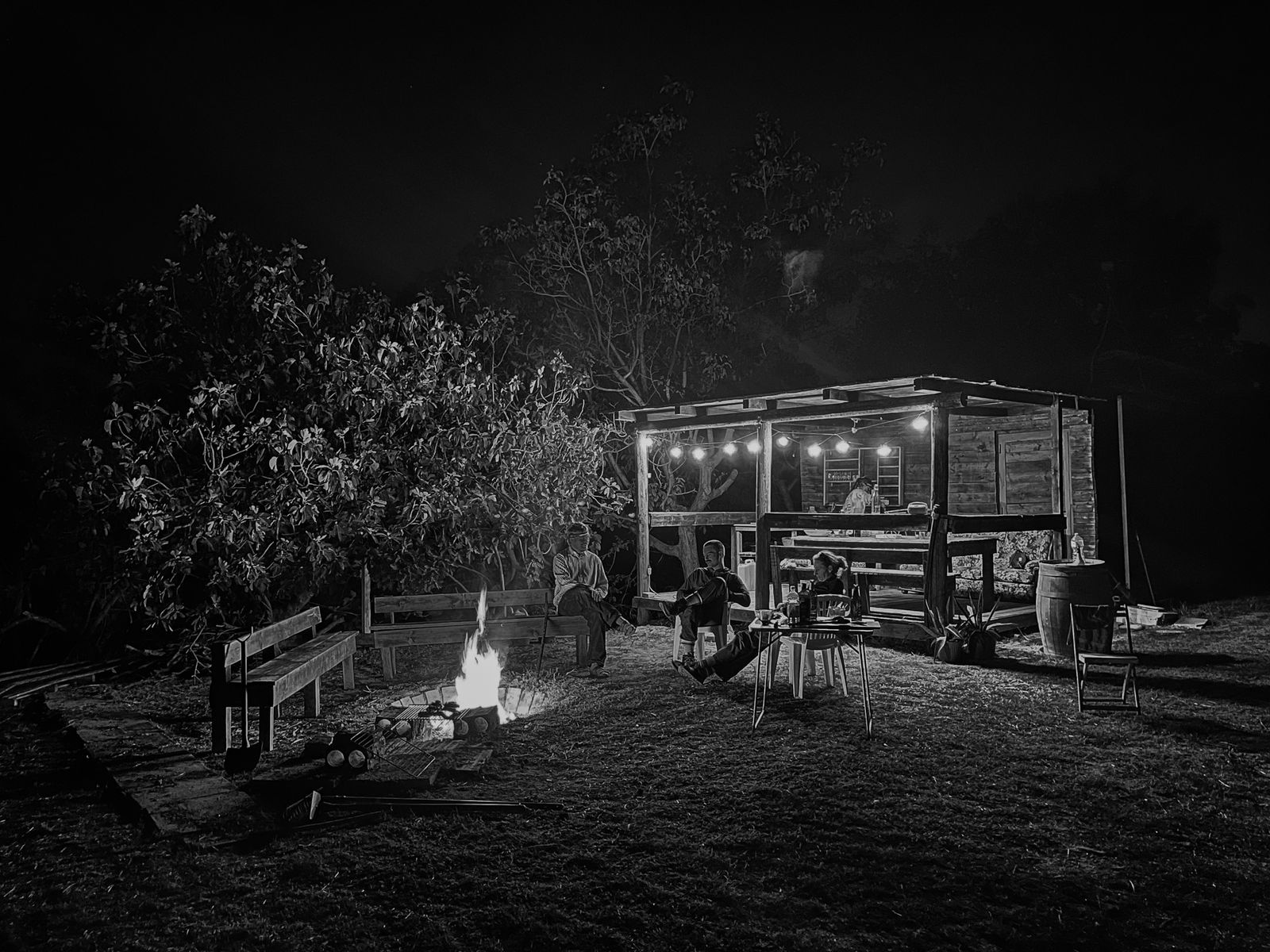
They are expert storytellers, populating the sonic landscape of Abruzzo with their dreamlike yowls. They alert me to how the legacy of Sentieri is sensorially abundant - the sound of dogs still echoes in my ears, even as I sit in a metropolitan Amsterdam cafe clacking away at my keyboard. As does the beat of the chopping board, the chug of the Transporter 2500, gurgling bottles of wine over dinner, crackling fires every other night. Of course, beyond the sonic footprint, Sentieri is bursting with flavour, curious smells, and tactile delights for the fingertips. The story of Sentieri is rich across the senses; any future-thinking anarchive must account for such multisensorial experiences of place.
The unabashed ease with which they burst through boundaries, fences, gates and open front doors is a source of great fascination. To these trespassing dogs, abiding by the laws of private land or impassable buildings demarcated by a map is pups-play. They reveal top-down cartography to be a farce. I think of the ambulatory Surrealists walking through a sultry post-war Paris in experiments of 'deambulation' or 'derives'. The Surrealists constructed counter-cartographies of liquid cities, walking, dreaming, and drifting through the sea between dense archipelagos of actions, populating the 'in-between' with action and reaction. This liquidical exploration provokes thoughts of further slipping beneath the surface, breaking the kind of up-down dualism of cartographies. In my time at Sentieri, I hope to contribute to a different kind of cartography - one that explores place as a fluctuating occurrence - and engaging with a kind of learning about how to write about landscape in a way that stretches beyond the observational.
As is the case before the researcher departs on a residency - and as is evident in this verdant article - my dreams, ideas and plans are blossoming in their abundance, spilling out in great florets, branching at every opportunity, and splaying their networks of roots ever-outwards. The task at hand is to capture this abundance without restraint, to find modes of presentation that permit a moveable and multisensorial experience with the past, present and future of Sentieri. By god, this is no simple feat. And yet, with each visit to the stone house on top of the crumbling driveway I better understand that this project with Sentieri is by no means bound to a single residency. Rather, what I, they, we are undertaking is a lifelong entanglement with land-based ideas; a prolonged dream of possible futures. I therefore approach this residency confident that, set within the distinct rhythms of Sentieri, my research has an abundance of time, space and fertile ground to grow.